Free tools · Play money · No signup
Crypto casino tools that show the maths.
Simulators for the games crypto casinos are built on, calculators for bonuses and rakeback, and a checker for provably fair bets. Everything runs in your browser. Nothing is real money.
8 simulators
Game simulators
 Simulator
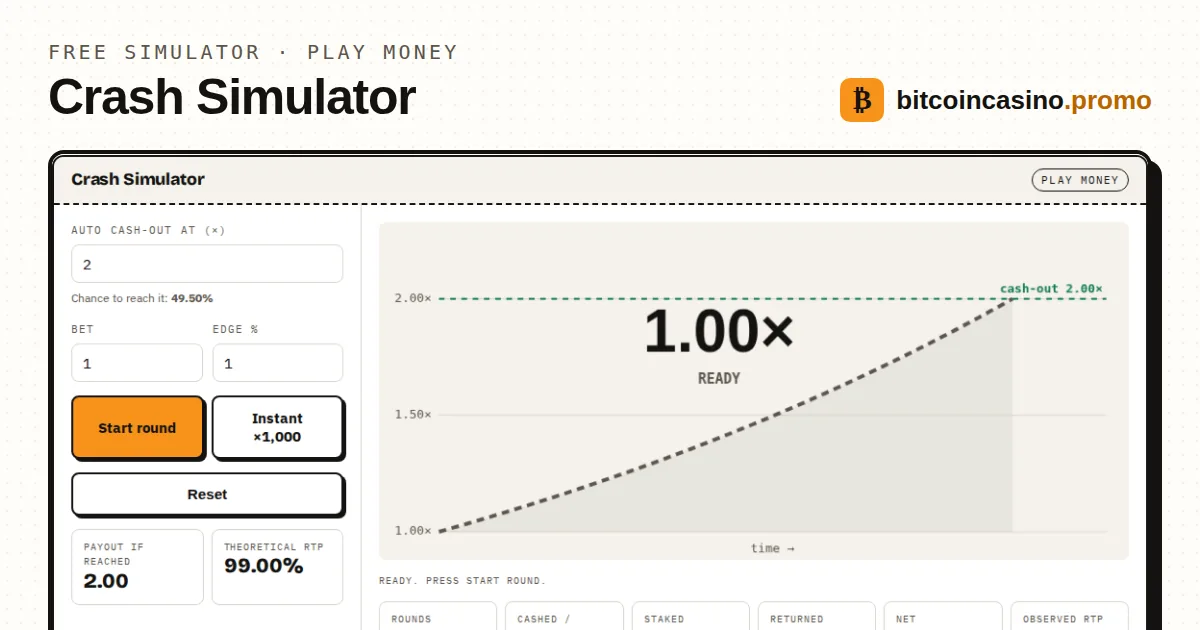
Crash Simulator
Set an auto cash-out, watch the multiplier climb and bust, then run 1,000 rounds to see the real crash game odds.
 Simulator
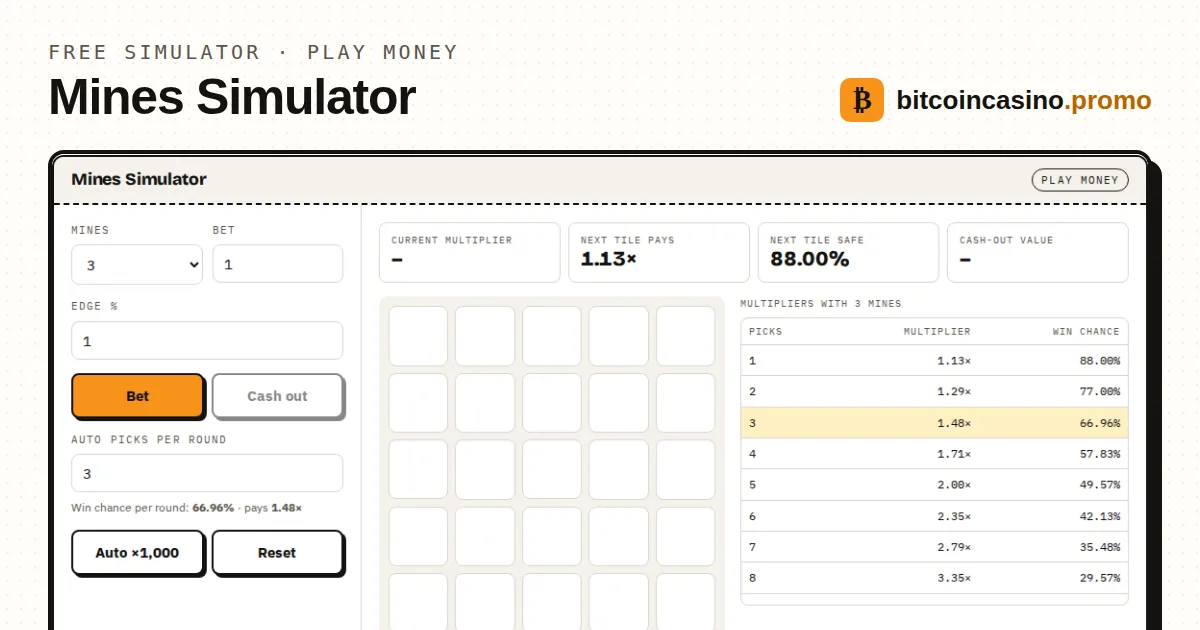
Mines Simulator
Play a 5×5 mines board with any number of mines, see every multiplier in advance, and auto-play 1,000 rounds.
 Simulator
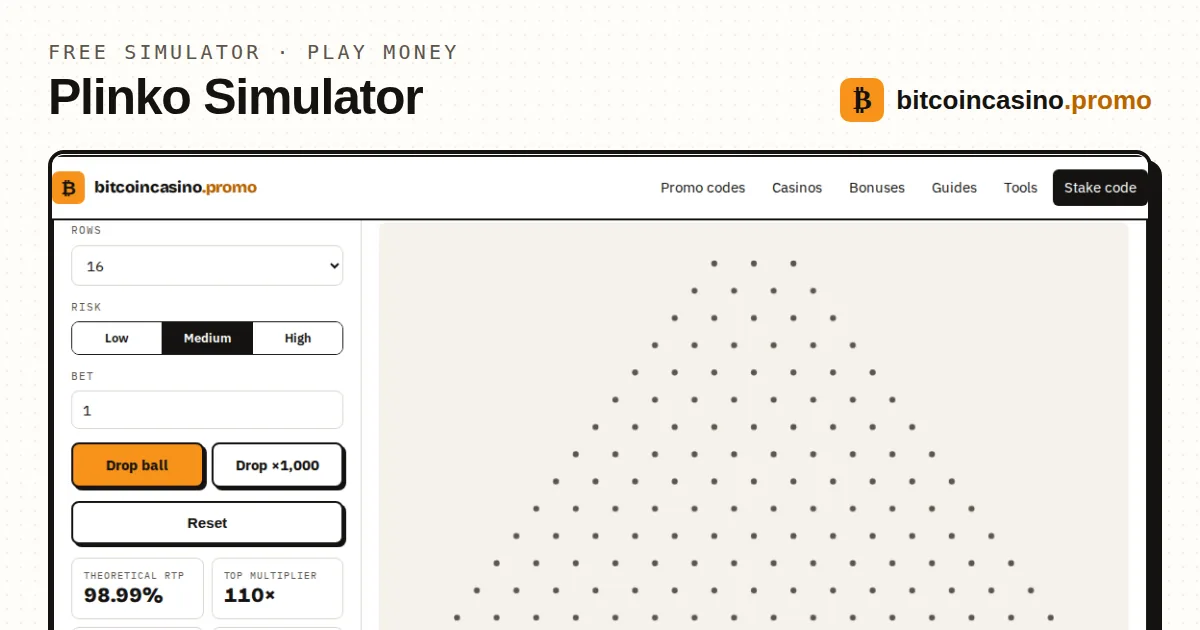
Plinko Simulator
Drop balls on an 8–16 row board, compare where they land with the exact binomial odds, and check the RTP of every risk level.
 Simulator
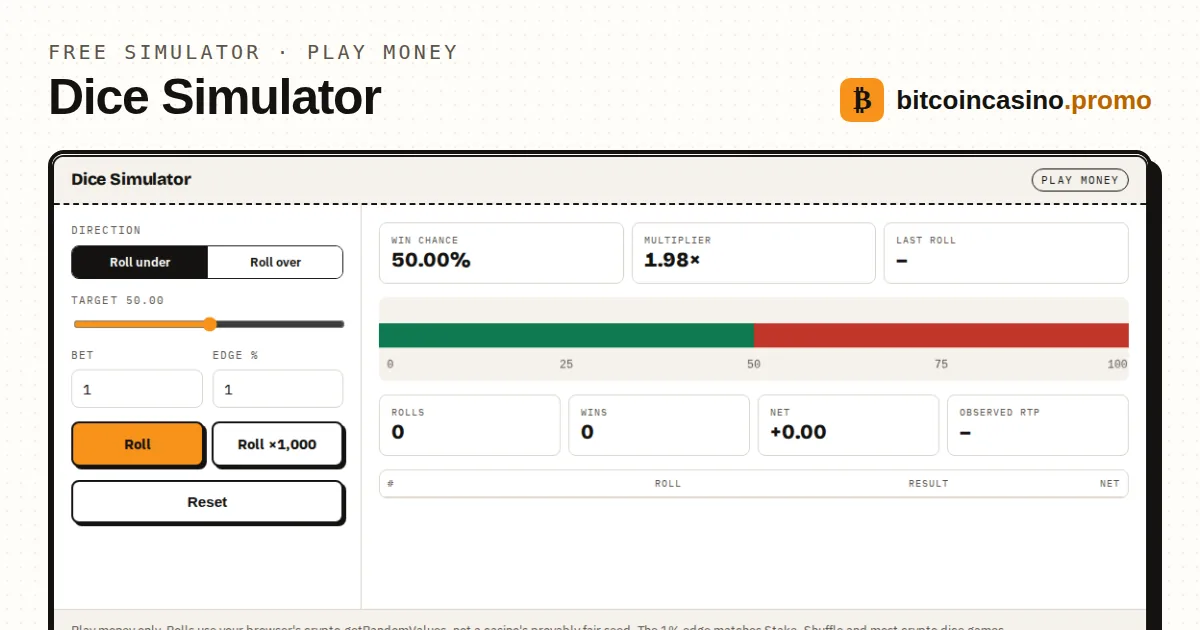
Dice Simulator
Set a target, see the true win chance and payout, then roll 1,000 times to watch the edge show up.
 Simulator
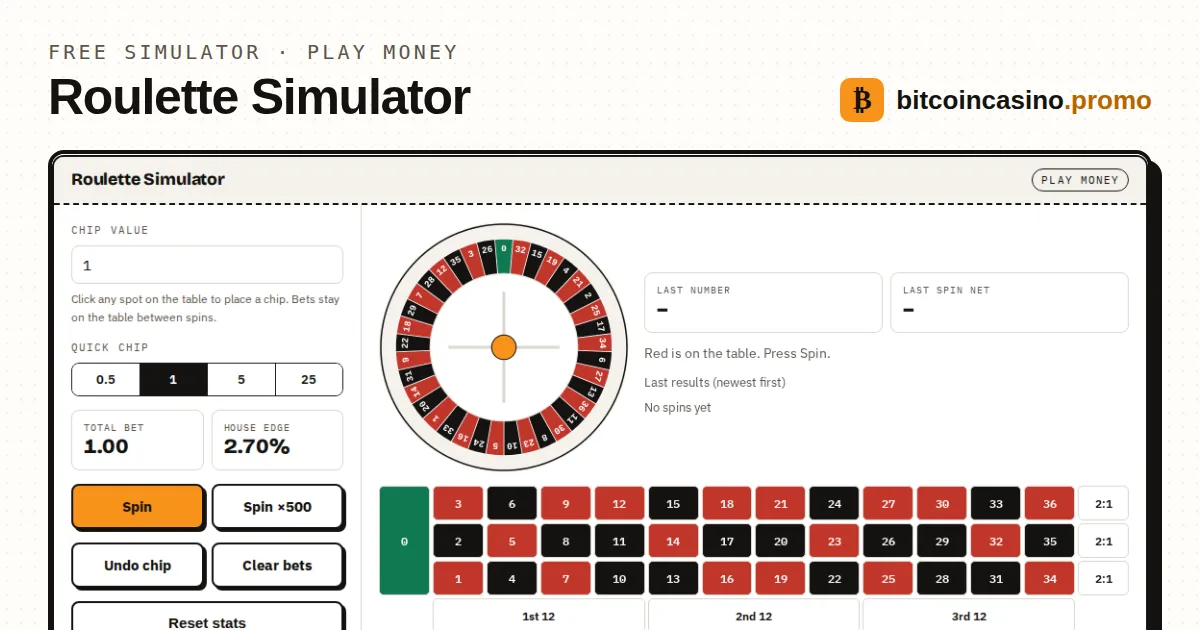
Roulette Simulator
Spin a single-zero European wheel, stack chips on any bet and watch 500 spins pull the RTP towards 97.30%.
 Simulator
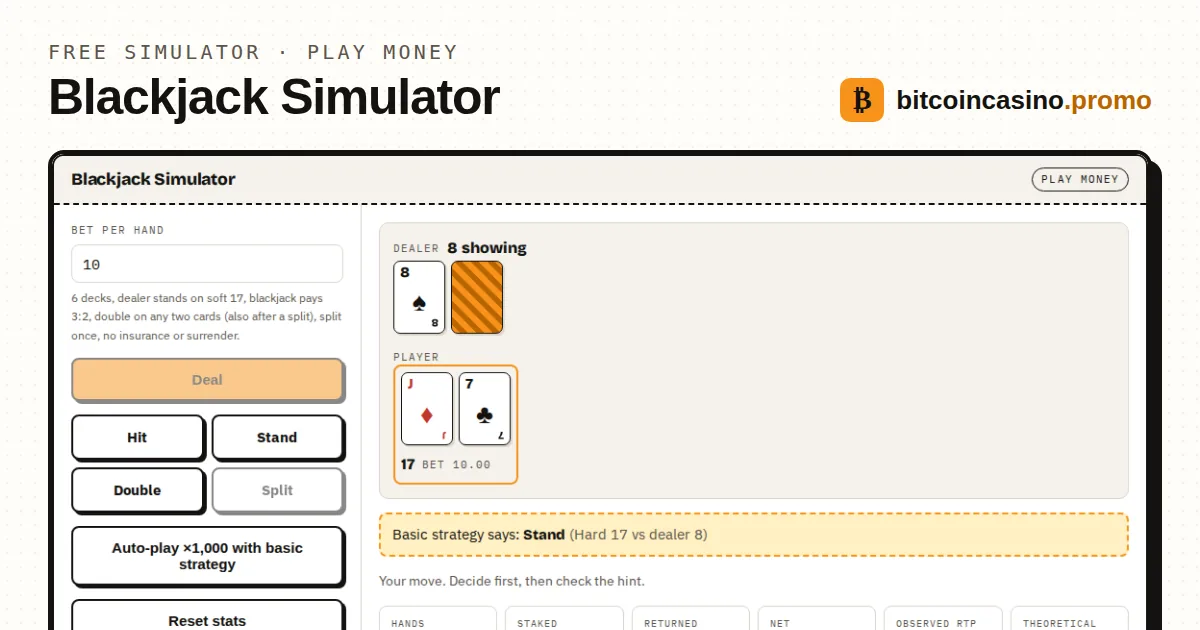
Blackjack Simulator
Play blackjack against a 6-deck shoe with a live basic strategy hint, then auto-play 1,000 perfect hands.
 Simulator
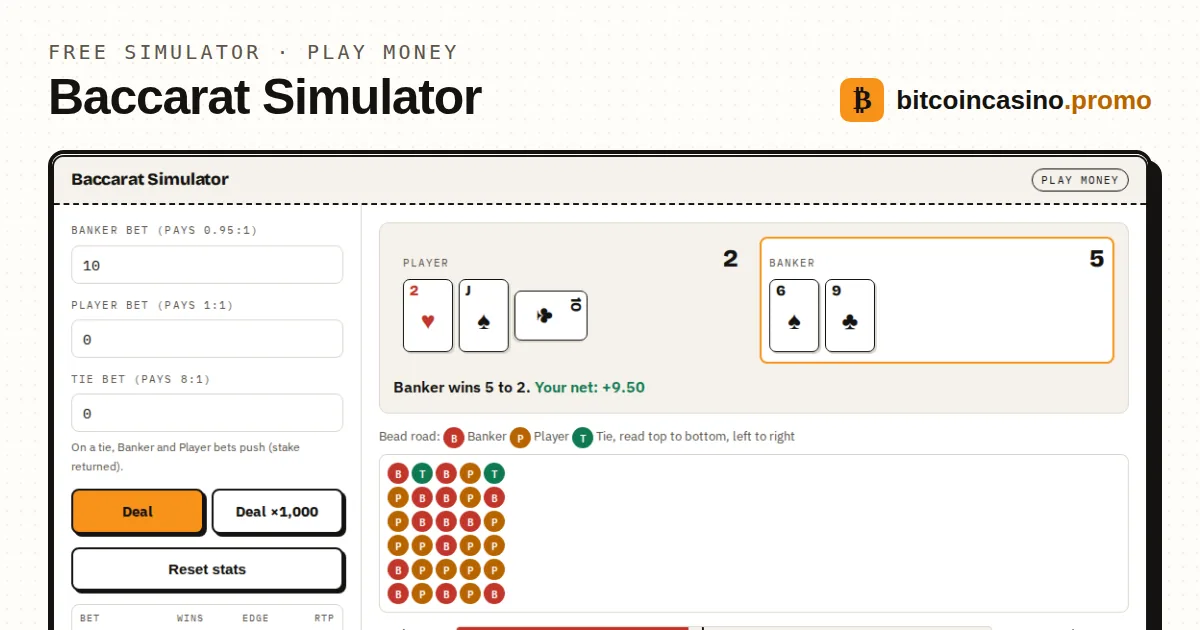
Baccarat Simulator
Deal punto banco from an 8-deck shoe, track a bead road and compare Banker, Player and Tie odds with theory.
 Simulator
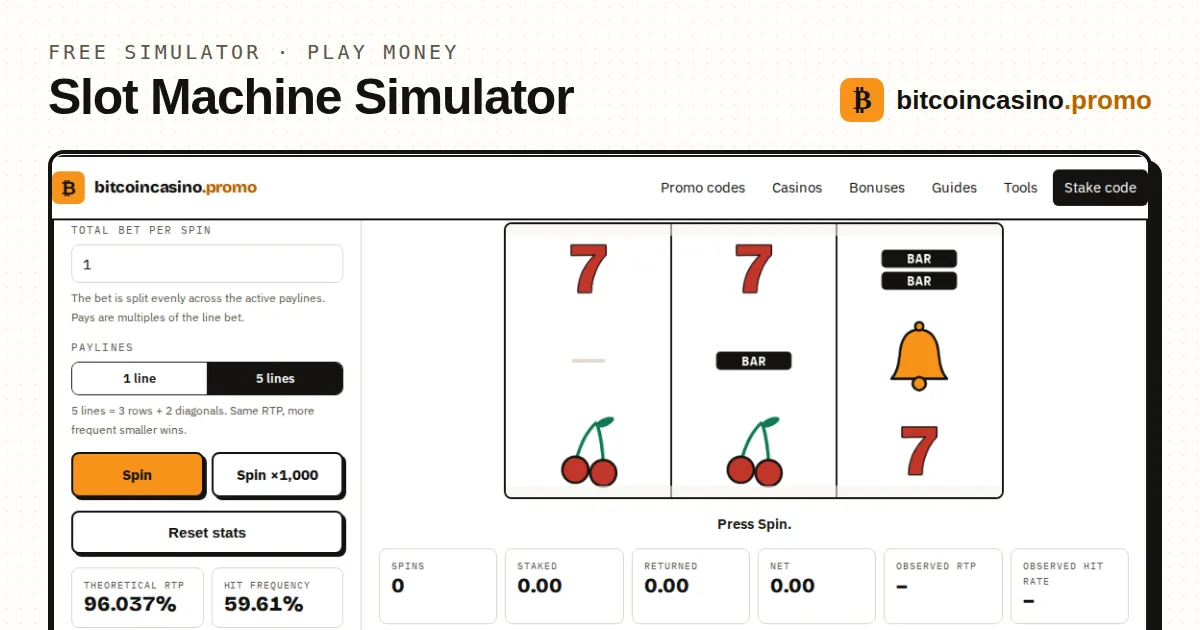
Slot Machine Simulator
A demo slot with its paytable and reel strips fully disclosed, an exact 96% RTP and a volatility breakdown.
4 calculators
Calculators
 Calculator
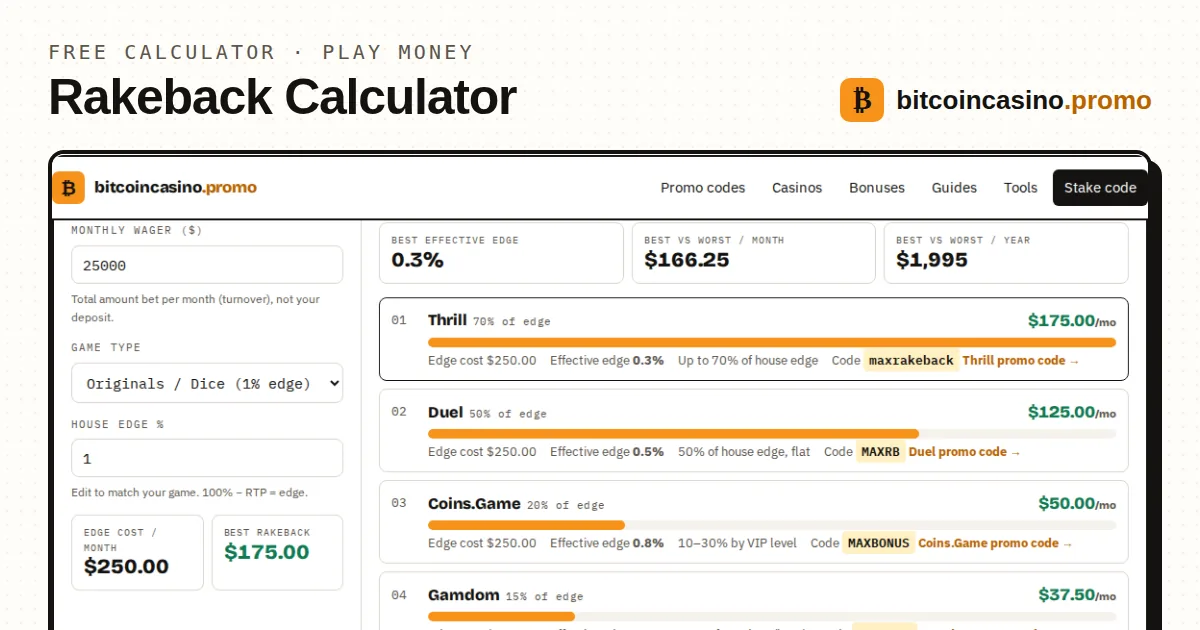
Rakeback Calculator
Enter your monthly wager and game type to see how much rakeback nine crypto casinos would pay you back.
 Calculator
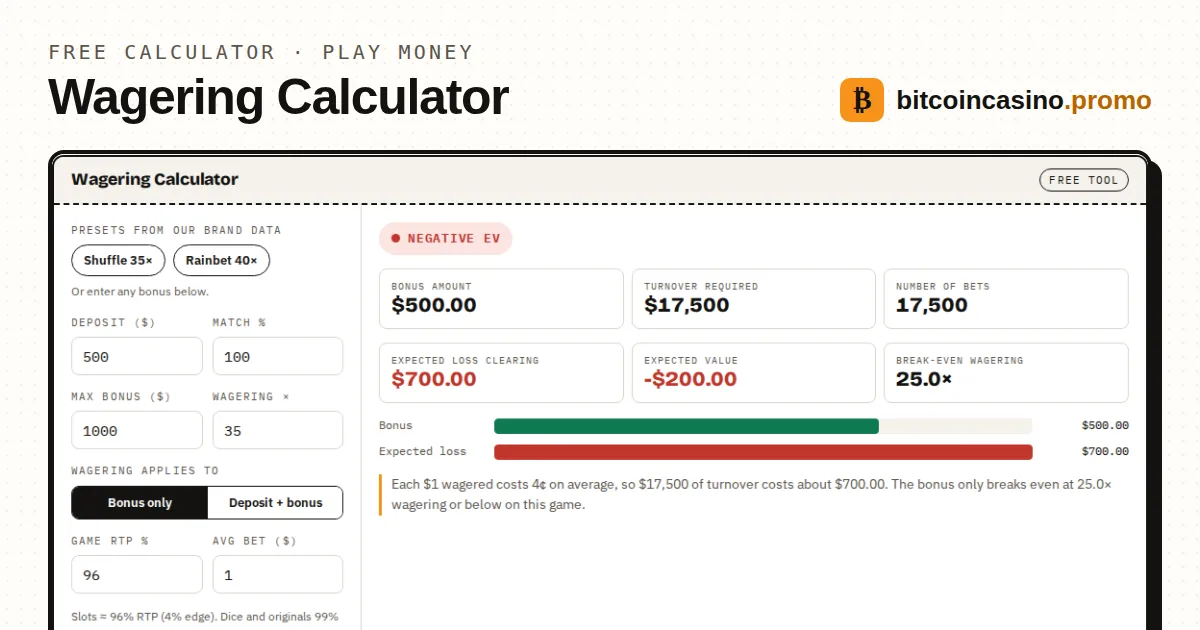
Wagering Calculator
Work out the turnover, expected loss and real value of a deposit bonus before you claim it.
 Calculator
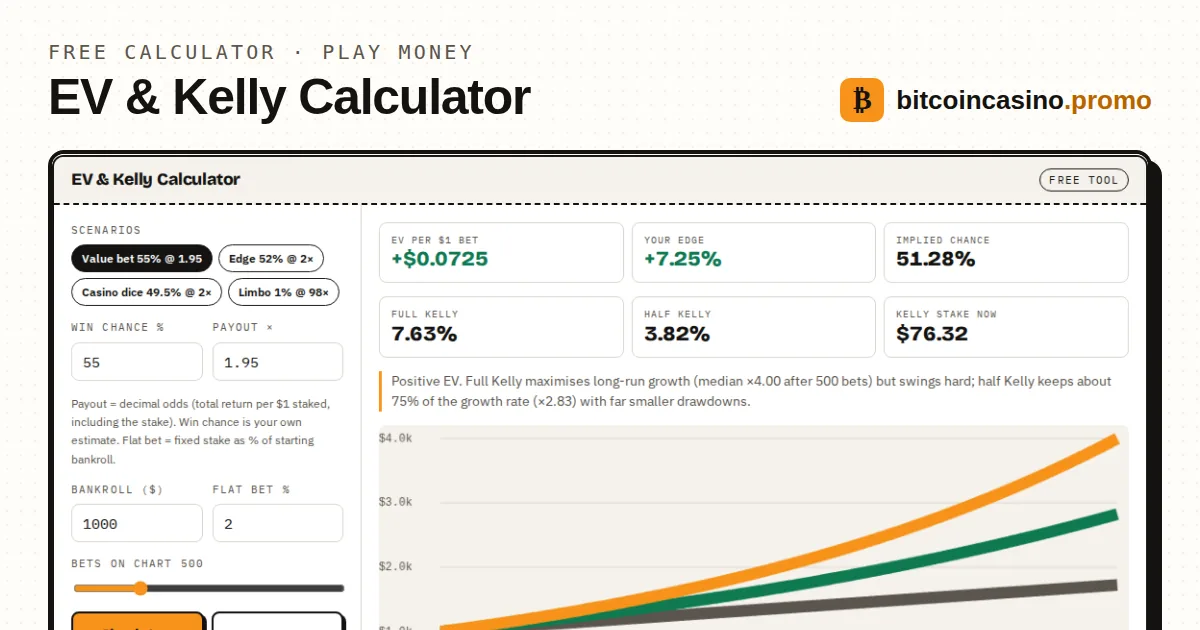
EV & Kelly Calculator
Get the expected value and Kelly stake for any bet, and see why casino games always come out at 0%.
 Calculator
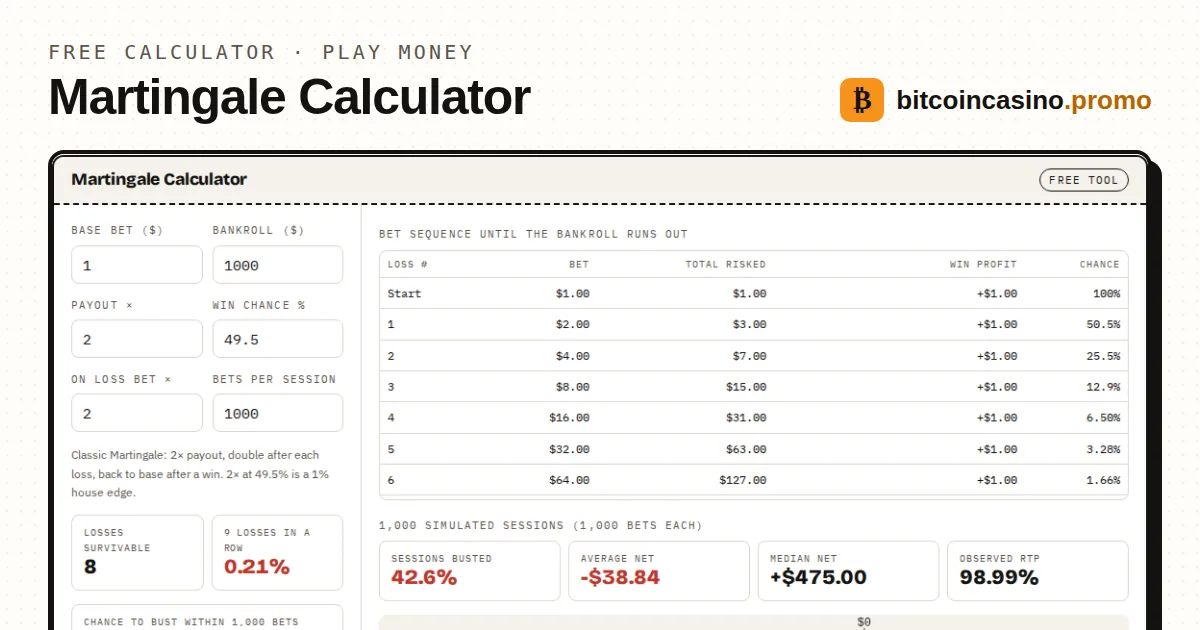
Martingale Calculator
See how many losses your bankroll survives with Martingale, your bust risk, and 1,000 simulated sessions.
What these tools are for
Casino games are built on simple maths, but you rarely get to see it. These simulators and calculators put the numbers on screen: the chance of each result, what it pays, and what that adds up to over hundreds or thousands of bets.
None of them use real money or connect to a casino. Simulators run on your browser's random number generator, and calculators work out averages from the terms you enter. Use them to understand a game or an offer before you play, not to predict your next bet.
Variance vs house edge: what the simulators show
Two numbers describe every game. The house edge is the average share of each bet the game keeps. Variance is how far your actual results swing around that average. The edge decides where you end up over a very long run; variance decides what a single session feels like.
Run 1,000 rolls on the dice simulator at a 49.5% chance and the expected loss is 1% of what you staked, yet one standard deviation of the result is about 3.1% of it. Run 500 spins of red on the roulette simulator and the spread is about 4.5 points around 97.30%. Bet a single number instead and it widens to about 26 points.
That is the main lesson. Over a session, luck swamps the edge, so a good night proves nothing about a game. Over many sessions the edge wins, which is why only a lower edge or rakeback changes your long-run cost. Run a batch, reset, run another, and watch the observed RTP move around before it settles.
Which tool answers which question
Start from what you want to know. Each row points to the tool built for that question.
| Your question | Tool |
|---|---|
| Does my cash-out target change my odds in crash? | Crash simulator |
| How many mines and picks should I use? | Mines simulator |
| Why do most plinko balls land in the middle? | Plinko simulator |
| What does each dice target pay, and how often? | Dice simulator |
| Do hot and cold roulette numbers mean anything? | Roulette simulator |
| How close to perfect is my blackjack play? | Blackjack simulator |
| Should I bet Banker, Player or Tie? | Baccarat simulator |
| What do RTP and volatility mean on a slot? | Slot machine simulator |
| How much rakeback would each casino pay me? | Rakeback calculator |
| Is this deposit bonus worth claiming? | Wagering calculator |
| How much should I stake when I have a real edge? | EV and Kelly calculator |
| How long would Martingale last with my bankroll? | Martingale calculator |
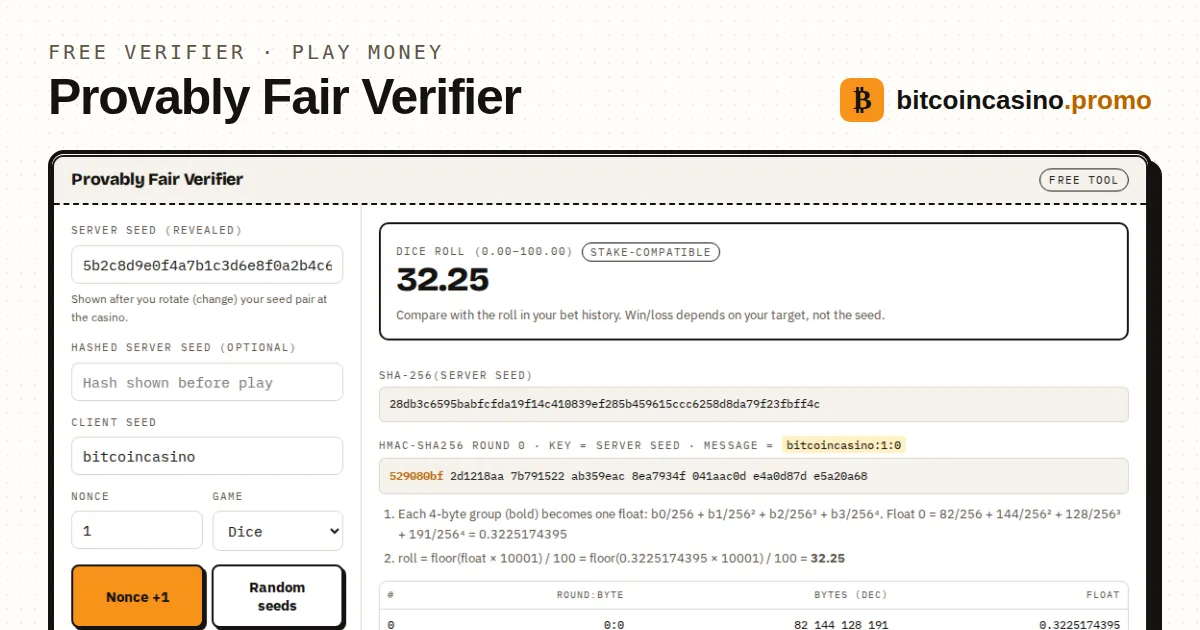
| Was my dice or plinko result really fair? | Provably fair verifier |
RTP of each simulated game
Each simulator uses a fixed payout model, and the theoretical return is shown on the tool page. These are the figures the simulators are built on, so you can compare them with what you observe.
| Game | RTP in the simulator | House edge | Notes |
|---|---|---|---|
| Crash | 99% | 1% | Same RTP for every cash-out target; limbo works the same way |
| Dice | 99% | 1% | Multiplier is 99 ÷ win chance; edge adjustable in the tool |
| Mines | 99% | 1% | Same RTP for any mine count and any stopping point |
| Plinko | about 99% | about 1% | Exact figure shown for each row count and risk table |
| European roulette | 97.30% | 2.70% | Same for every bet on a single-zero wheel |
| Blackjack, basic strategy | about 99.5% | about 0.5% | 6 decks, dealer stands on soft 17, 3:2, double after split |
| Baccarat, Banker | 98.94% | 1.06% | 5% commission on Banker wins |
| Baccarat, Player | 98.76% | 1.24% | Pays 1:1 |
| Baccarat, Tie | 85.64% | 14.36% | Pays 8:1 |
| Demo slot | 96.0% | 4.0% | 96.04% from all 10,648 reel stop combinations |
Real casinos set their own payouts. Crypto originals usually match the 1% figures, but always check the game's info screen. The house edge guide lists typical edges across more games.
The limits of play-money results
A simulator shows how a game behaves under a known model. It cannot tell you what a particular casino's game will do, and it cannot warn you about a streak, because each round is independent of the last.
Results also feel different without real money at stake. Losing 300 play units in a batch is easy to shrug off; losing the same amount of crypto is not. Treat a winning batch as noise, not as evidence that a strategy works. No pattern of bets changes the expected loss, which is always turnover times the edge.
The calculators have limits too. They use average edges and the published rates, while caps, VIP tiers, game weighting and time limits in a casino's terms can make the real result worse.
Use the tools responsibly
Use a simulator to learn a game, then stop. If you find yourself running batches to hunt for a system, or wanting to win back play-money losses with real money, take a break.
Gambling is for adults (18+, or older where local law requires) and is a paid form of entertainment, never a way to make money. Our responsible gambling page covers limits, warning signs and where to get help.
FAQ
Common questions
Are these casino simulators accurate?
They use the same payout formulas as typical crypto originals and fair random numbers from your browser. Over thousands of rounds the observed RTP settles near the theoretical figure shown on each tool page.
Can a simulator help me win at a real casino?
No. It shows how a game's odds and variance work, but every bet at a casino still carries the house edge. No strategy tested here changes the expected loss.
Why does my observed RTP differ from the theoretical one?
Variance. Short runs swing widely around the average. The demo slot can show 80% or 115% after 1,000 spins; the gap narrows as you add more rounds.
Do the tools send my inputs anywhere?
No. Simulators and calculators run entirely in your browser, and the provably fair verifier computes hashes locally. Nothing you type is sent to us.
Which tool should I use before claiming a bonus?
The wagering calculator for deposit matches, and the rakeback calculator to compare rakeback codes on your own monthly wager.